
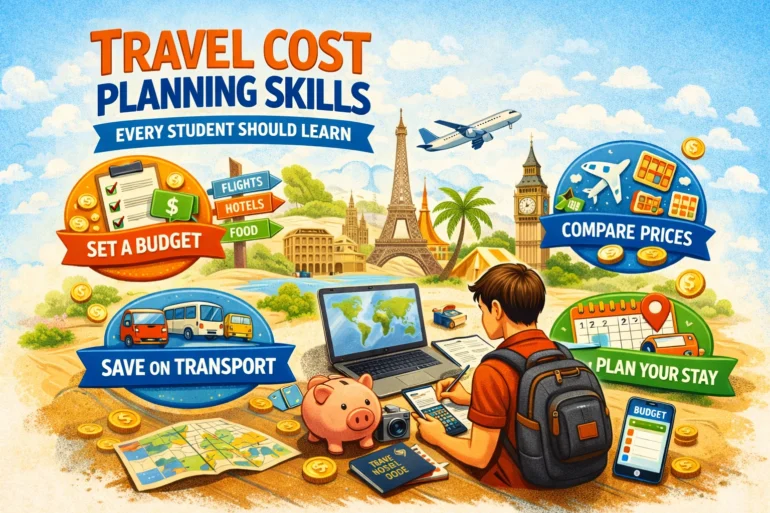
There are many students who have the desire to travel, yet money may be an issue. The majority of them lack the financial means and have regular spending on studying and living. Due to this, journeys can be difficult to organize. Nevertheless, mere planning will assist. Travel can be possible when you are familiar with how to create a budget, monitor your expenses, and manage the costs. In this guide, you will learn the key skills step by step. We cover how to plan your budget, monitor expenses, and avoid common mistakes.
The Role of Budget Planning in Student Travel
Travel seems simple at first. Then costs start to grow. Fast. Many students have tight budgets, so every choice matters. That’s why budgeting for a trip helps. It keeps spending under control and avoids money problems on the road. With a plan, it’s clear what’s affordable and where the money goes.
Key reasons to plan travel costs:
- Limited budget
- Better control over spending
- Less stress during the trip
- Useful money habits for daily life
Good planning often depends on simple calculations. This is similar to tasks students already face in their academic life. For instance, just as a STEM student might use a limit calculator to find the boundaries of a complex function, a traveler must find the upper limits of daily spending to avoid running out of money before the trip ends. Clear numbers help make better choices, and even small adjustments can keep a budget on track.
Travel Budget Structure and Planning Basics
To begin with, make the key decisions of the trip. Consider where you want to go, the duration of the travel, and the type of traveling that suits your budget. These fundamentals are useful in knowing how much money you require.
Define the Basics
Pick a destination, choose the number of days, and choose the type of travel to understand how to travel on a budget. The decisions influence the overall cost. Even short journeys are half the price. Budget constraints assist in cost reduction. Thereafter, divide the expenses into transport, accommodation, food, and activities.
Break the Budget Into Parts
A budget that is divided into distinct sections is simpler to handle. First, this assists in demonstrating the amount of money being spent. It also simplifies cost adjustment in case of necessity. Transport and accommodation occupy approximately 60-70 % of the budget and therefore should receive the greatest consideration on most occasions.
- Transport
- Accommodation
- Food
- Activities
Then, set a total budget based on your savings and income. If the amount is too high, change the plan. For example, pick cheaper options or shorten the trip. In this manner, the budget remains realistic and more manageable.
Calculate and Compare Travel Prices
Write down all major expenditures before booking. This can be avoided in the future. An obvious travel budget begins with transport and accommodation because most of the cash is normally consumed on these. Then weigh up alternatives. A low-cost airline might turn out to be an expensive one, including the cost of baggage. The cheap hotel on the outskirts of the city can result in an increase in transportation expenses per day.
| Category | Typical Cost Range (per day/trip) | What to watch |
| Transport | $30–$150+ | Baggage fees, airport transfers |
| Accommodation | $15–$80+ per night | Location, extra charges |
| Food | $20–$50 per day | Eating out vs cooking |
| Activities | $5–$50 per entry | Tour prices, ticket fees |
| Insurance | $10–$50 per trip | Coverage details |
| Emergency fund | 5–15% of the total budget | Unexpected costs |
Then check all costs together. Transport, stay, food, and activities take most of the travel budget. Don’t forget insurance and a small emergency fund. Extra fees matter too. Baggage, local transport, and booking charges can build up fast. When every cost is clear, it’s easier to compare options and keep spending under control.
Plan Savings and Manage Income
Money planning begins with an understanding of how much enters and how much can be saved. Part-time jobs or small savings are sources of income for many students. This is the initial process of budgeting for a trip. After that, set clear goals. A monthly saving of between $150 and $300 can be achieved by saving between $5 and $10 a day. It is already enough to pay for the transportation or even some nights in a hotel.
Then, there is the daily spending that has to be taken care of. It is at this point that the issue of how to budget a trip comes in handy. Small expenses such as coffee, snacks, or small rides can be low, but they can be up to $100 or higher a month. Reducing some of them helps to make more savings within a shorter period. To illustrate, by foregoing a $4 coffee a day, you will be able to save about $120 in a month. In case of a short trip, which is aimed at $300, this may be divided into $75 per week. This simplifies the plan to follow and puts spending under control.
Daily Spending Control During Travel
Many students lose control of their money during a trip, even if they plan well before. This is why daily tracking is important. It shows how much is spent and how much is left. This step is part of how to create a travel budget that works in real life, not only on paper.
A daily budget helps avoid overspending. For example, if the total budget is $300 for 5 days, the daily limit is about $60. Daily control methods:
- Set a daily budget
- Review spending each evening
- Use simple apps like TravelSpend, Splitwise, or Revolut
Check spending every day and match it with your plan. If costs go up, act fast. Pick meals for $8 instead of $15. Skip one paid activity. These small steps matter. Over a few days, they can save $30–$50. Small daily changes keep the budget on track and avoid problems later.
Avoid Hidden Costs and Use Discounts
Additional expenses are reflected in the traveling and drive the budget up. They are missed by many students at the beginning. There are baggage charges, exchange rates, tourist levies, and internet phone data. Each one looks small. The two can bring it to $50-$150 per trip. Meanwhile, discounts may contribute to minimizing the expenses. Student cards, such as ISIC, are cheaper on transport and attractions. Expenses can also be reduced through travel deals. Early booking can be more economical, and flexible dates can make a trip cheaper. Combine these steps, and spending stays under control.
Smart Planning Skills Students Can Use in Study and Travel
Good planning starts with simple thinking and clear steps. Many students already use these skills in their studies. The same approach works for travel. When costs are clear and decisions are based on numbers, it is easier to stay within budget. This is an important part of student budget travel, where every small decision can affect the total cost. Key skills students can use:
- Break costs into smaller parts
- Compare options before choosing
- Track numbers and check totals
- Set clear limits for spending
- Plan steps in advance
- Adjust plans when needed
- Use tools for quick calculations
These skills then come into play in real life. Indicatively, calculating a daily budget becomes simpler, weighing the options in transport, or where to cut on the money becomes easier. This method is more economical, and students are in a better position to remain organised. In the long run, these habits will also serve in study work, in which clear procedures and simple calculations will result in improved outcomes.
Planning Skills Every Student Should Learn
When traveling is planned simply and clearly, it becomes easier. Under those conditions, when costs are tracked and decisions made based on a budget, it becomes easy to avoid trouble as well as keep within reach.
Learning to go on short trips is a good beginning. An example is a weekend trip, which can be used to test a budget where there is not a huge risk. With time, such skills become better and facilitate subsequent trips to be planned. They can also be applied in everyday life and learning. Spending and money management, as well as making explicit decisions, are useful in a variety of situations beyond travel.
What say you?
Thoughts on these Planning Skills Every Student Should Learn?
Let’s hear it!